
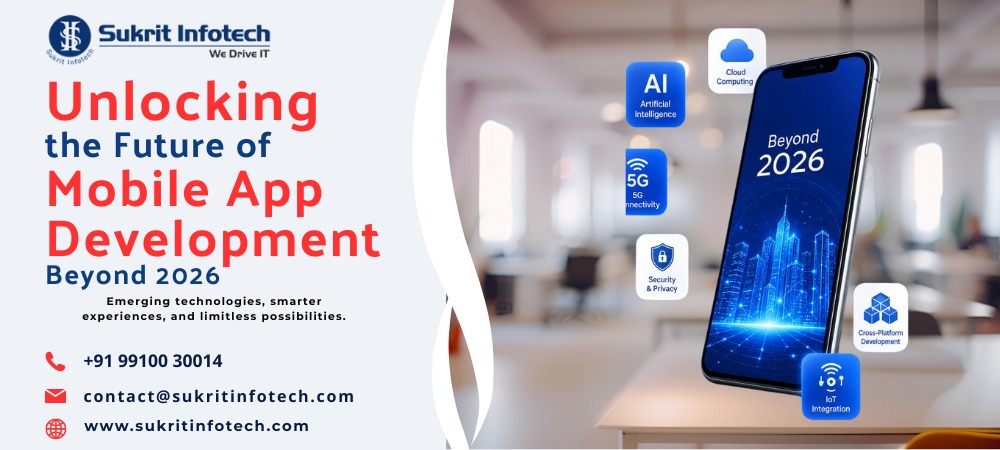
Mobile app development has transformed how people communicate, shop, work, learn, and manage everyday activities. Beyond 2026, the industry is moving into a new phase where applications will become smarter, more connected, and more adaptive to user needs.
The next generation of mobile applications will focus on delivering experiences rather than simply providing functionality. Businesses that prepare now can create stronger customer relationships and remain competitive in an increasingly digital world.
The Evolution of Mobile Apps: From Utility to Intelligent Experiences
Earlier mobile applications were built to complete specific tasks such as messaging, shopping, or booking services. Future applications will go much further.
Mobile apps beyond 2026 are expected to become:
- Context-aware
- AI-driven
- Personalized
- Device-independent
- Privacy-focused
- Continuously evolving
Applications will increasingly understand user behavior and adjust experiences automatically.
Artificial Intelligence Will Drive Mobile Innovation
Artificial Intelligence is becoming a core component of modern mobile application development.
Future mobile applications will use AI for:
Hyper Personalization
Apps will deliver customized recommendations, content, and workflows based on user activity and preferences.
Conversational Experiences
Voice interactions and intelligent assistants will become more common across industries.
Predictive Functionality
Applications will anticipate user actions and provide faster, more relevant responses.
Automation
Businesses will automate customer support, operations, and internal processes through intelligent mobile solutions.
AI will help applications become proactive rather than waiting for user input.
Cross Platform Development Will Continue to Grow
Companies are increasingly looking for efficient development methods that reduce cost and accelerate launch timelines.
Cross platform approaches provide benefits such as:
- Faster deployment
- Lower development costs
- Easier maintenance
- Consistent user experiences
Future mobile products will be built to operate across:
- Android
- iOS
- Tablets
- Wearables
- Smart displays
- Connected devices
Flexibility and scalability will remain major priorities.
Super Apps Will Expand Digital Ecosystems
Users prefer convenience and fewer downloads.
Super apps combine multiple services into a single platform, including:
- Payments
- Messaging
- Commerce
- Service bookings
- Customer support
- Entertainment
This integrated approach reduces friction and increases engagement.
Businesses are increasingly evaluating ecosystem-based mobile strategies instead of isolated applications.
Edge Computing Will Improve Speed and Performance
As mobile apps become more advanced, performance expectations continue to rise.
Edge computing supports:
- Reduced latency
- Faster processing
- Improved responsiveness
- Better real time experiences
Industries expected to benefit include:
- Healthcare
- Manufacturing
- Logistics
- Smart mobility
- Real time collaboration
Users will expect seamless performance regardless of location.
Extended Reality Will Redefine User Interaction
Extended Reality technologies including AR, VR, and MR are opening new opportunities.
Examples include:
Retail
Virtual product experiences before purchasing.
Education
Interactive learning environments.
Real Estate
Digital property exploration.
Healthcare
Remote training and support.
Entertainment
Immersive digital engagement.
Mobile devices will increasingly serve as gateways to interactive environments.
Privacy and Security Will Become Competitive Advantages
Users are becoming more selective about how applications collect and use data.
Future mobile applications will prioritize:
- Transparent privacy practices
- Secure authentication
- User consent controls
- Data encryption
- Regulatory compliance
Building trust through security will become essential for long-term growth.
Low Code and No Code Development Will Accelerate Innovation
Development tools continue to become more accessible.
Benefits include:
- Faster application delivery
- Lower technical barriers
- Increased experimentation
- Better internal productivity
Professional developers will remain essential while organizations gain greater flexibility.
IoT Will Create Connected Mobile Experiences
Mobile applications are evolving into control centers for connected environments.
Future integrations may include:
- Smart homes
- Wearables
- Connected vehicles
- Industrial systems
- Healthcare devices
These ecosystems will create new business opportunities and improve user convenience.
Sustainable Mobile Development Will Gain Importance
Sustainability is becoming a larger consideration in digital product development.
Future practices may include:
- Efficient app performance
- Reduced energy consumption
- Optimized cloud usage
- Long term device compatibility
- Cleaner infrastructure management
Businesses will increasingly balance performance with environmental responsibility.
How Businesses Can Prepare for the Future
To remain competitive beyond 2026, businesses should focus on:
- Investing in scalable architecture
- Prioritizing user experience
- Leveraging AI capabilities
- Strengthening security frameworks
- Exploring connected technologies
Companies that adapt early will be better positioned for long-term growth.
The future of mobile app development beyond 2026 will be shaped by intelligence, personalization, connectivity, and trust.
Applications will become more than digital tools. They will evolve into responsive platforms that understand users, integrate across ecosystems, and continuously deliver value.
Businesses that embrace innovation today can unlock stronger growth opportunities and create mobile experiences that remain relevant for years to come.
Frequently Asked Questions
1. What is the future of mobile app development after 2026?
Mobile app development after 2026 is expected to focus on AI integration, personalized experiences, connected ecosystems, stronger security, and cross-platform compatibility.
2. How will Artificial Intelligence impact mobile applications?
AI will enable predictive features, intelligent automation, conversational interfaces, and personalized user experiences that improve engagement and efficiency.
3. Will native mobile development still remain relevant?
Yes. Native development will continue to be important for performance-intensive applications, while cross-platform solutions will expand for broader business requirements.
4. What industries will benefit most from future mobile technologies?
Healthcare, retail, education, manufacturing, finance, logistics, and entertainment are expected to see major benefits.
5. Why is privacy becoming important in mobile app development?
Users increasingly expect transparency and secure data practices. Privacy-focused applications can improve trust and customer retention.
6. What role will IoT play in mobile app development?
IoT will allow mobile apps to connect and manage smart devices, creating seamless digital experiences across environments.
7. Are low code and no code platforms replacing developers?
No. These platforms accelerate development, but experienced developers remain essential for architecture, customization, and complex functionality.
8. How can businesses prepare for the future of mobile apps?
Businesses should invest in scalable technology, strengthen security, adopt AI capabilities, and focus on creating user-centered digital experiences.